

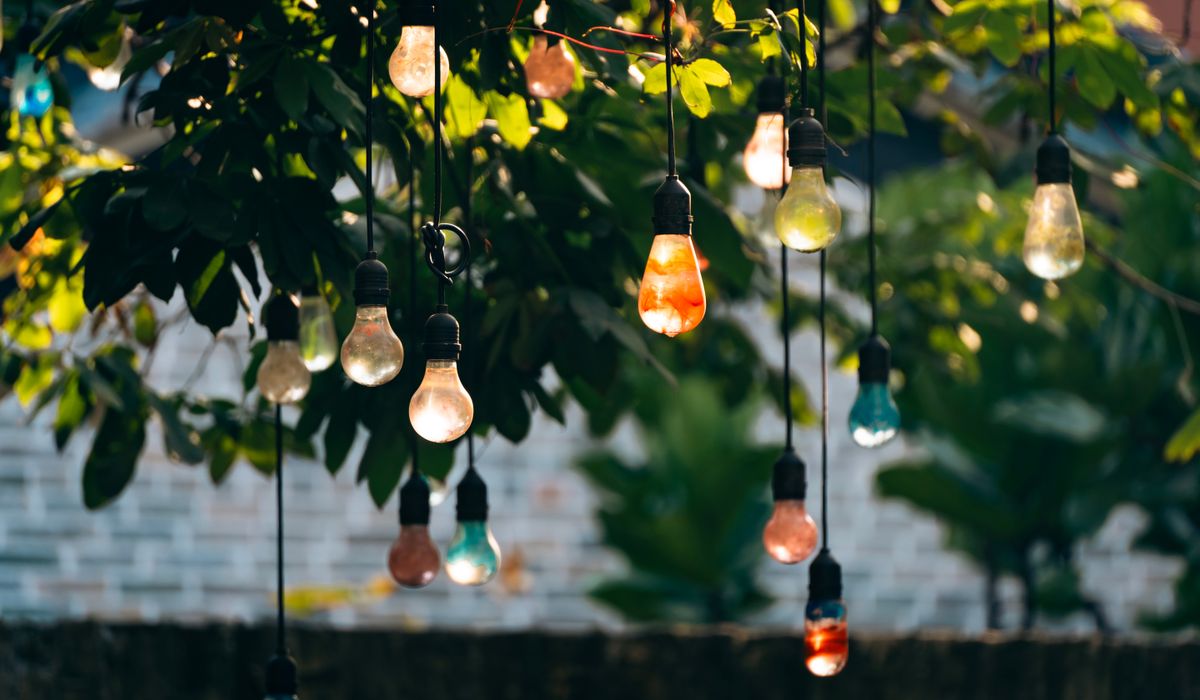
Living rooms rarely go stale overnight. They fade slowly — a lampshade that has yellowed, a bulb that casts that flat blue light, a corner that has never quite been lit properly. The good news is that lighting is the cheapest way to make a familiar room feel new again, and most of it can be done in an afternoon with a step ladder and a screwdriver.
Start with the shades, not the sofa
New lampshades are the fastest, most affordable change in the room, and they alter the character of a scheme more than most people expect. A tired cream drum can be swapped for a pleated cotton or a tapered empire shade and the whole corner reads differently.
- Get the proportions right. A shade should be roughly two-thirds the height of the lamp base, and at least as wide as the base at its widest point. Too small and it looks apologetic; too big and it swamps the table.
- Check the sightline. With the lamp on a side table, the bottom edge of the shade should sit at roughly eye level when you are seated. Any higher and you will see the bulb; any lower and you will squint past the glare.
- Choose fabric over plastic. Linen, cotton and silk diffuse light softly and give a warmer pool of light. Metal and glass shades throw light in a tighter beam, which is useful for shelves but harsh beside a sofa.
- Measure your fittings. Most table lamps take a 40mm E27 screw cap or a B22 bayonet cap — check before ordering, and note whether the shade is held by a ring or a harp.
Layer your light in threes
Almost every tired room has the same fault: one ceiling light doing all the work. A room feels generous and calm when it has three types of light working together.
- Ambient — the overall wash, from a ceiling fitting or an uplighter bouncing off the walls. Keep it low and dimmed for evenings.
- Task — a floor lamp beside a reading chair, or a table lamp close to the arm of the sofa. This is the light you actually use.
- Accent — a picture light, a small lamp on a bookshelf, or a warm uplighter tucked behind a large houseplant. This is the layer that gives depth.
Put the layers on separate switches where you can. Being able to run just the corner lamp while the ceiling stays off turns a functional room into a relaxing one after dark.
Make room for one statement floor light
If you buy one thing from this list, make it a floor light. Freestanding lighting solves the problem of a room with no ceiling wiring and no free table space, and it gives you a focal point without moving furniture.
An arc lamp works beautifully in a bay window or the alcove beside a chimney breast, leaning light over a seating area. A tripod or wooden-legged design suits a more traditional British sitting room and is lighter on the eye than a heavy base. For smaller rooms, a slim rise-and-fall or a column lamp at around 150–160cm tall will do the job without crowding the space.
Allow about 40–45cm between the shade and the arm of your chair so the light falls on the page rather than over your shoulder. If you have a low sofa, look for a lamp with a downward-facing shade and a reach of at least 30cm.
Get the bulb warmth right — this is where most schemes fall down
You can spend hundreds on lamps and undo it with the wrong bulbs. Colour temperature is measured in Kelvin, and it matters far more than most shoppers realise.
For living rooms, stay between 2200K and 2700K — that soft, slightly golden white that feels like candlelight. Anything from 4000K upwards is cool daylight, designed for garages and offices, and it will make a warm scheme look clinical. Ignore wattage as a guide to brightness; look at lumens instead. A table lamp is comfortable at around 400–500 lumens, while a reading floor lamp wants closer to 800 lumens.
Buy dimmable bulbs even if your lamps are not on dimmers yet — you will thank yourself later. If you do fit a dimmer switch, check it is compatible with LED bulbs and choose a trailing-edge dimmer if you want flicker-free low-level light. And keep every bulb in the room the same colour temperature, otherwise the mismatch is obvious the moment both are on.
Five practical fixes worth doing while you are at it
- Tidy the cables with adhesive clips or a fabric sleeve in a matching colour, running them along the skirting rather than across the floor.
- Fit smart plugs so the corner lamps can come on together from one button or a timer, rather than you crawling behind the sofa each evening.
- Add a dimmer to the main ceiling light — it is the single most-used control in the room.
- Move the switch if you have to walk into a dark room to find it; a wireless switch plate is an easy retrofit.
- Clean the shades — dust and cooking film can soak up a surprising amount of light, so a gentle wipe can genuinely brighten a room for nothing.
Do two or three of these and the room will feel considered again, without a single tin of paint being opened.



John Doe
14 January, 2022Having no content in post should have adverse..
Chauffina Carr
10 April, 2022We use these tests all time! Killer stuff!
Jim Séchen
16 July, 2022Thanks for all the comments, everyone!