

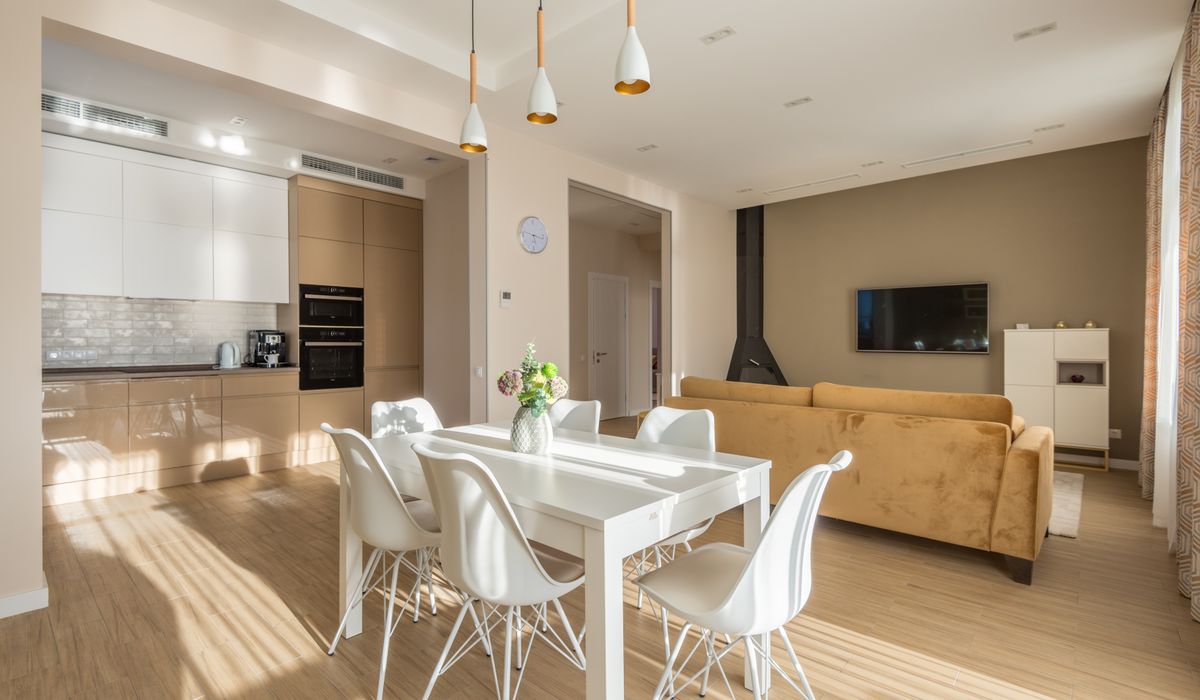
Why a windowless hallway needs a different approach
Hallways with no natural daylight are the hardest rooms in the house to light well, and the reason comes down to contrast. In a room with a window, your eye adjusts to a soft, even wash of light bouncing off walls, ceilings and floors. In an internal corridor there is nothing to bounce. Every surface is lit only by whichever fitting you have pointed at it, which is why a single pendant tends to leave bright pools on the floor and gloomy shadows in the corners — and why a corridor barely a metre wide can still feel like a tunnel.
The answer is not simply more brightness. It is layering: a gentle ambient wash from above, warmer vertical light on the walls to widen the space visually, and a low-level glow for late-night trips. Get those three working together and a dark hall quietly becomes one of the most welcoming parts of the home.
Start with the ceiling fitting
In most British halls the ceiling is the ceiling height you have to work with, so measure first. If your hall is under about 2.4 metres high, or narrower than 1.2 metres, stick to a flush or semi-flush fitting. A pendant needs roughly 2.1 metres of clearance from floor to the bottom of the shade so nobody walks into it, and in a tight corridor a low-hanging shade will only make the space feel narrower.
For brightness, work on roughly 100–150 lumens per square metre as a starting baseline. A hall measuring 3 metres by 1.2 metres is about 3.6 square metres, so aim for 400–600 lumens minimum from your main fitting — then add layers rather than pushing one fixture harder.
Colour temperature matters more than most people expect. Choose 2700K to 3000K warm white. Anything at 4000K or above reads as clinical in a residential hall, makes skin tones look grey in the mirror, and turns a hallway into a corridor of an office block.
If you prefer downlights, run three or four in a line down the centre, spaced roughly 1 to 1.2 metres apart with a wide 60–90 degree beam. Keep them 50–60 centimetres from the walls unless you are deliberately washing the wall — a soft scallop of light up a plain wall is a cheap way to make a ceiling look taller. Always put them on a dimmer.
Wall lights do the heavy lifting
Wall lights are the single best investment in a daylight-free hall. They put light where the ceiling cannot: at eye level and along the walls, which visually pushes the walls outwards and makes a narrow space read as wider.
- Mount them with the centre of the fitting about 1.7–1.8 metres from the floor — high enough to keep the bulb out of your eyeline, low enough that the light still spills up and down the wall.
- Space them 1.5–2 metres apart, ideally a third of the way along each wall rather than jammed into corners.
- Choose fittings with a shade, diffuser or frosted glass. A bare bulb at head height is glare, not lighting.
- In a hall under 1.2 metres wide, keep the projection under about 15 centimetres so shoulders and shopping bags clear it.
- Specify IP44 if the fitting sits near the front door, where draughts and damp air gather.
- Wire them as a pair on their own switch, and ask your electrician about two-way switching so you can turn them on at one end of the hall and off at the other.
Mirrors, paint and reflective surfaces
A mirror is not a light source, but it multiplies one. Place it where it will catch the reflection of a wall light or ceiling fitting — usually on a long wall, at a height where the light source lands within the glass. A mirror hung directly opposite a glowing wall light effectively doubles the visible glow and makes the hall feel twice as wide.
What you want to avoid is a mirror facing a dark doorway, or facing a glazed front door that turns into a black rectangle after dark. At night that reflection reads as a hole in the wall, and it will make the space feel colder rather than brighter.
Surfaces matter just as much. Keep the ceiling a shade lighter than the walls, choose pale or mid-tone paint in a wipeable finish, and consider satinwood or a low-sheen gloss on doors and skirting to pick up and bounce a little light without looking shiny. A pale runner or light-toned flooring does more for a dark hall than an extra light fitting ever will.
Layering for real life
One switch for everything means you get either full brightness or darkness. Split the lighting into two or three circuits instead — a main ceiling light, the wall lights, and a low-level option. Arriving home with shopping needs brightness; a 3am trip to the bathroom needs almost none.
For that low level, LED strip along the underside of the stair nosing, or a plug-in motion sensor light, works beautifully. A PIR sensor set to a short timer means no fumbling for a switch, and it uses a fraction of the energy of leaving a ceiling light on. A small battery or rechargeable lamp on a console table adds a warm pool of light at about 400 lumens and 2700K, and gives the hall a lived-in feel rather than an airport feel.
Buying checklist before you spend
- Think in lumens, not watts. An old 60W bulb was around 700 lumens; a modern LED does the same for a fraction of the running cost.
- 2700–3000K for every fitting in the hall. Mixing temperatures makes a small space look muddled.
- Dimmer compatibility: LEDs generally need a trailing-edge dimmer, and some have a minimum load below which they flicker or buzz. Check before you buy.
- Replaceable bulbs (GU10 or E27) are usually a better long-term bet than sealed integrated LED fittings.
- Check the ceiling. A heavy pendant needs a joist or a proper fixing, not just plasterboard.
- Plan the switching before the walls are decorated — adding a two-way switch is far cheaper during a rewire than afterwards.
- Use a registered electrician for any new circuit or work at the consumer unit, and keep the certification on file for when you sell.
Get the layering right, keep the colour warm, and a hallway with no window at all can end up feeling brighter and more generous than the rooms it leads to.



John Doe
14 January, 2022Having no content in post should have adverse..
Chauffina Carr
10 April, 2022We use these tests all time! Killer stuff!
Jim Séchen
16 July, 2022Thanks for all the comments, everyone!